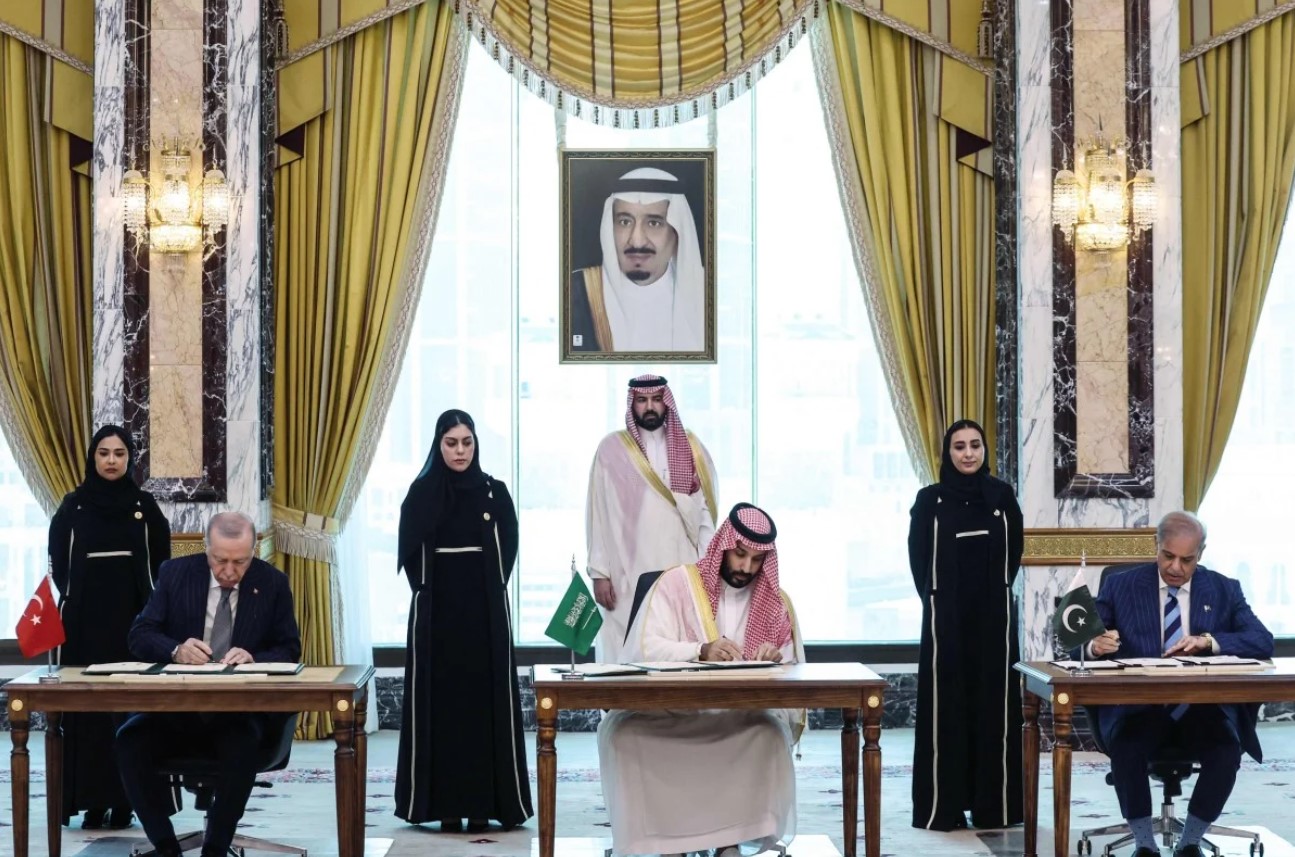
Mecca Agreement 2026: Saudi Arabia, Pakistan and Türkiye Sign Joint Defense Pact
Saudi Arabia, Pakistan, and Türkiye have established a new trilateral defense agreement in Makkah, which sets a foundation for collective security and enhanced military collaboration among the three nations.
On August 7, 2026, Saudi Arabia, Pakistan, and Türkiye formalized a significant Joint Defence Agreement in Makkah, which bolsters defense and security cooperation between these three strategic allies.
This agreement has garnered international interest due to its collective-defense clause, which stipulates that an armed attack on any one of the three nations will be regarded as an attack on all.
The agreement emerges in the context of increasing security concerns throughout the Middle East and the rising initiatives by regional countries to fortify defense alliances.
What Is the Mecca Agreement?
The Mecca Agreement, known as the Mecca Joint Defence Agreement, is a trilateral security and defence pact involving Saudi Arabia, Pakistan, and Türkiye.
This agreement lays out a framework for enhanced collaboration in defence and security issues. The most crucial aspect of the agreement is the principle of collective defence.
According to the agreement, any armed aggression against one member nation will be regarded as an attack on all three nations.
Turkish Foreign Minister Hakan Fidan noted that the principle of collective defence is technically akin to the concept found in Article 5 of the NATO treaty, although this new agreement should not be viewed as equivalent to NATO.
The collective-defence principle is the most crucial aspect of the agreement.
If any of the three signatory nations faces an armed attack, it will be regarded as an attack on all three nations.
Nonetheless, this does not imply that a specific military response will be triggered automatically in every case.
The nature and extent of assistance will be determined by the context of the attack and the choices made by the involved countries.
Potential areas for collaboration may encompass intelligence sharing, military coordination, and various forms of security support.

The principle of collective defense has been likened to NATO’s Article 5, which states that an armed attack on one member is considered an attack on the entire alliance.
Nonetheless, the Mecca Agreement is not NATO and should not be viewed as a direct counterpart to the NATO alliance.
NATO is a significant, well-established military coalition with a permanent institutional framework, integrated military commands, and decades of operational expertise.
In contrast, the Mecca Agreement is a trilateral defense framework that includes Saudi Arabia, Pakistan, and Türkiye.
Thus, the most precise characterization is that the agreement features a collective defense principle similar to NATO’s Article 5, rather than labeling it as a Middle Eastern equivalent of NATO.
For Saudi Arabia, the agreement could strengthen its strategic defence partnerships beyond its existing security relationships.
The Kingdom occupies a central position in the Gulf and has faced a range of regional security challenges in recent years.
Closer defence coordination with Pakistan and Türkiye could provide additional avenues for military cooperation, intelligence sharing and strategic coordination.
Saudi Arabia also maintains strong economic and political relationships with both countries, giving the defence agreement a broader strategic context.
What Does the Agreement Mean for Pakistan?
For Pakistan, the agreement further strengthens its longstanding strategic relationship with Saudi Arabia while creating a wider security framework with Türkiye.
Pakistan has maintained defence cooperation with Saudi Arabia for decades and also has strong military and defence-industry ties with Türkiye.
The trilateral arrangement could create additional opportunities for cooperation in areas such as:
- Defence training
- Military exercises
- Intelligence cooperation
- Defence technology
- Security coordination
- Strategic planning
The agreement also places Pakistan within a broader regional security framework involving two important strategic partners.
What Is Türkiye’s Role?
Turkey contributes substantial military and defense industry capabilities to the partnership.
As a member of NATO, Turkey possesses considerable experience in multinational defense collaboration. In recent years, its domestic defense industry has seen significant growth, especially in sectors like unmanned systems, naval platforms, armored vehicles, and various military technologies.
This agreement may offer Turkey an additional avenue to enhance strategic defense cooperation with Saudi Arabia and Pakistan.
Officially, the agreement is not directed against Iran or any specific country.
Turkish Foreign Minister Hakan Fidan has said that the agreement does not target Iran or another particular state.
The agreement is presented as a collective security framework rather than an alliance against a named adversary.
However, the pact has received increased attention because it was signed during a period of heightened tensions and security concerns in the wider Middle East.
It is therefore important to distinguish between the regional context surrounding the agreement and its stated purpose.

Saudi Arabia, Pakistan and Türkiye: A Strategic Partnership
The significance of the Mecca Agreement also comes from the existing relationships between its three members.
Saudi Arabia and Pakistan
Saudi Arabia and Pakistan have historically maintained close political, economic and defence relations.
Defense cooperation between the two countries has existed for decades, making Pakistan an important security partner for the Kingdom.
Pakistan and Türkiye
Pakistan and Türkiye also share strong strategic and defence ties.
The two countries have cooperated in military training, defence production and other areas of security cooperation.
Saudi Arabia and Türkiye
Saudi Arabia and Türkiye have expanded their economic and strategic engagement in recent years.
The new defence framework connects these bilateral relationships into a broader trilateral security arrangement.
Mecca Agreement 2026: Key Points
Here are the most important facts about the new agreement:
- Saudi Arabia, Pakistan and Türkiye signed the agreement on August 7, 2026.
- The agreement was signed in Makkah, Saudi Arabia.
- It establishes a trilateral framework for defence and security cooperation.
- An armed attack against one member is to be treated as an attack against all three.
- The collective-defence principle has been compared with NATO Article 5.
- The agreement is not the same as NATO and does not create a NATO-style alliance.
- The pact is not officially directed against Iran or another specific country.
- The three countries may strengthen cooperation in defence, intelligence and security.
- Future expansion to additional countries remains possible.
- Egypt has been mentioned in discussions about potential future participation.
About Gulfeed
Gulfeed is your trusted source for the latest UAE and Gulf news, visa guides, business insights, investment updates, jobs, and lifestyle information. Our goal is to provide accurate, easy-to-understand, and regularly updated content to help residents, visitors, professionals, and investors make informed decisions across the GCC.
For UAE Visit Visa: Please click here.
For UAE Employment Visa: Please click here.
For UAE Investment Visa Guide: Please Click here.
For 5 year Multiple Entry Visa: Please click here
For latest news must visit :
https://www.gulfeed.com
For the quickest and most dependable Updates, along with live interactive charts on Fuel Prices, Gold Rates, and Commodity changes across the GCC and the World , be sure to bookmark Gulfeed!
For Flight Booking, Get Exclusive Discounted prices at Flight Booking page.
For visa guide, Must Visit UAE, Saudi Arabia, Oman, Bahrain, Kuwait & Qatar Visa guide Pages.
For any Help or Inquiry, Please contact us at Admin@gulfeed.com, Team@gulfeed.com